
Date
December 15, 2025
Category
Diversification
You already know your capabilities. You’ve spent years, maybe decades, refining them. However, when every company in your space claims to be “best in class,” capabilities alone cease to be a differentiator.
What moves the needle now is how well you understand and use the research behind your story.
Because research goes beyond a data exercise. It’s how you uncover what truly sets you apart.
Most manufacturers have a general sense of their strengths. But there’s often a gap between what you believe your story is and what the market actually sees.
“We don’t start with what you think your story is. We start with what the market actually sees.”
When Anthology conducts a landscape assessment, we look at your competitive environment — who’s saying what, who’s being remembered, and where the white space exists.
Sometimes the results confirm what you already knew. More often, they reveal what’s missing.
Good research doesn’t just tell you how you stack up against others. It tells you what to stop saying.
“Sometimes research isn’t about what to add. It’s about what to stop saying because everyone else already is.”
Everyone’s talking about innovation, workforce development, and community investment. Those are table stakes now.
What’s rare is proof. And proof comes from specifics: certifications, compliance records, longevity, and capital investment strategy.
Those are the details that move you from capable to credible.
There’s a temptation to assume certain things automatically matter to your audience. Certifications, compliance, years in business…
But until you’ve done the research, you don’t actually know which of those proof points move the needle.
“Research helps you figure out which proof points are worth putting front and center, and which ones your audience doesn’t value as much as you think.”
Perhaps your buyers prioritize cybersecurity and CMMC compliance due to their position in the supply chain. Or maybe they’re focused on sustainability and workforce stability. Either way, you can’t guess. You have to validate.
When you use research to understand what your market values most, you can prioritize the story elements that prove you belong in their consideration set instead of wasting time emphasizing the ones that don’t.
Longevity is powerful, but only if it’s positioned through insight.
“Sometimes, the most powerful story is that you’ve been here 30 years and that you’re still evolving. But you have to know if that matters to your audience before you lead with it.”
Research helps you determine whether your track record builds confidence or if your audience is more focused on what’s next: innovation, automation, or workforce expansion.
When you use research to see how your audience perceives maturity versus modernization, you can balance both stories.
That’s how you turn experience into evidence, and evidence into credibility.
The companies that win aren’t necessarily the ones with the most impressive metrics. They’re the ones who translate those metrics into meaning.
“We take what we find in the research and build it into the story. That’s how it sticks.”
Research gives you proof for your message, but a story gives it power. A capability statement or an ISO certification by itself is just information. But, when you connect it to the larger narrative, i.e., how you support national security, how you strengthen your regional workforce, it becomes a differentiator.
Manufacturing is evolving fast. Private equity is flooding in. Policy priorities are shifting every quarter.
If you haven’t revisited your market position in the last year, you’re probably behind on how others are talking about themselves.
“If you haven’t revisited your position lately, you’re probably missing how fast everyone else is changing theirs.”
Research helps you stay proactive, enabling you to lead the narrative rather than react to it.
Every strong story starts with something measurable. When you understand your market, the policies, players, and proof points, you stop relying on assumptions and start communicating from a position of authority.
“When you understand the landscape, you stop reacting to competitors and start leading the narrative.”
Because the companies that know their story best don’t wait for someone else to define it for them. They build it, back it with research, and use it to grow in every direction: new markets, new clients, new opportunities.That’s what it means to compete beyond capabilities.
In manufacturing, everyone’s talking about innovation, reshoring, workforce, national security, and economic impact. You’re all saying the right things. But only a few companies are being heard.
That’s because we live in a world of relentless noise, more than 13 hours of media a day, competing for our attention. Social feeds, podcasts, newsletters, streaming platforms, even the endless scroll of background noise make every message fleeting.
You might make the best components, build the most advanced systems, or engineer the most precise technology in the world, but you can’t outsmart that level of noise with cleverness.
You outlast it with consistency.
If you want to stand out to policymakers, partners, or future talent, your message can’t be a one-and-done. It has to become a rhythm, a steady beat that reinforces your value every time someone encounters your brand.
Familiarity builds trust, especially in complex, technical industries. Your audiences don’t live inside your world. They don’t understand your technology like you do, and that’s okay. What matters is that they recognize your value when it matters most.
“When your message shows up in the same tone, same look, same promise, that’s when people start to believe you.”
Consistency is the quiet work that builds recognition over time.
When your audience sees the same message reflected across your website, media coverage, and leadership communications, they start to believe it’s not a campaign, it’s your identity.
That’s how you move from just another option to the obvious choice.
Let every message hit the same emotional and strategic note until it becomes second nature, for you and for them.
Once your foundation is consistent, the next step is to make it memorable. Your message needs a chorus.
Like a song with a familiar chorus, your message should sound the same no matter the verse.
That chorus might be your role in the defense industrial base.
Your impact on your regional workforce development and economic growth
Or your leadership in reshoring advanced manufacturing.
Whatever your why is, that’s the piece to repeat.
When people start finishing your sentences or echoing your message in meetings, that’s when you know your story is sticking.
“Think of it like songwriting. The chorus is what people remember, not the bridge or the verse. That’s your message consistency.”
Many leaders worry about overexposure.
But truthfully? You’re far more likely to under-reinforce your story.
Repetition isn’t just how audiences remember you; it’s how markets learn to rank you.
You might share a great piece of thought leadership once, or tell your workforce story at one event, and assume it landed.
It didn’t. Not because it wasn’t good, but because your audience didn’t have time to remember it.
“A slightly imperfect message said often will outperform a perfect one no one ever sees.”
In markets this competitive, clarity and repetition are your greatest differentiators.
Social posts, website copy, and press interviews should all reinforce the same core ideas. Change the tone, examples, or visuals, but not the core market positions or value.
That’s how you build a recognizable voice that cuts through the clutter and remains consistent across all platforms.
In advanced manufacturing and defense, credibility is built by showing up the same way, again and again, until the people who matter most start repeating your story for you.
“Good communications aren’t about shock value. They’re about shaping what sticks.”
So say it again.
And again.
And again.
Because in a world of constant noise, the brands that win aren’t the ones who shout the loudest, they’re the ones people can finish the sentence for.
How manufacturers can expand across industries without diluting their identity
Diversification is growth’s great paradox. For manufacturers expanding into new markets, especially those in both defense and commercial sectors, the real challenge isn’t always production, capital, or capacity. It’s consistency.
The most challenging question in growth isn’t what you build next. It’s how you describe who you are when different audiences expect different things.
Defense buyers value stability, compliance, and reliability above all else. Commercial buyers prioritize speed, adaptability, and innovation. Both expectations are valid, but if your message shifts too much between them, your company can start to sound uncertain.
At Anthology, we often see this moment: manufacturers are ready to scale, but their market position hasn’t yet caught up. The solution isn’t two different stories; it’s one well-defined identity that flexes intelligently across audiences.
That constant—your anchor—is your strategic core. It’s the problem you solve, the value you create, or the purpose that drives your growth. When it’s clearly defined, every new partnership, product, or proposal connects back to something stable.
Here’s how to find it:
Many teams discover they’ve been describing their company differently for years. Once everyone aligns around one central idea, expansion becomes less chaotic, and growth communication becomes deliberate and disciplined.
Different buyers demand different proof points, but that doesn’t mean you need different identities.
A defense customer may require evidence of reliability, cybersecurity compliance, and audit history.
A commercial buyer may prioritize agility, cost, and speed to market.
Your identity stays the same, your examples change. We often help clients create a Message Map, a single-page framework that keeps the core value narrative at the center and shows how that story adapts for each market.
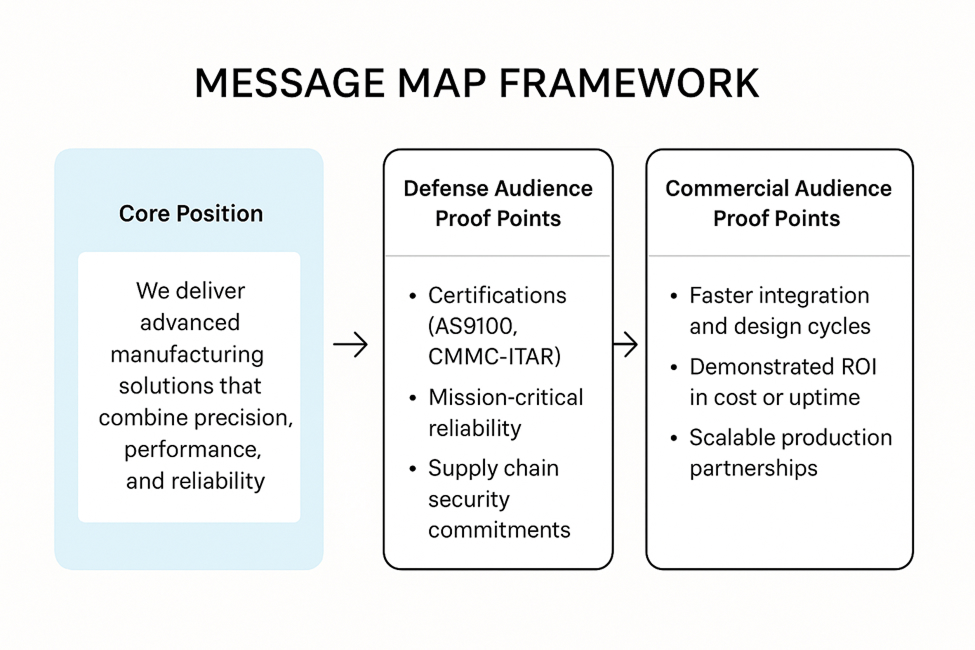
This kind of structure protects your consistency. It ensures your brand equity travels intact across audiences without creating competing versions of your company.
Most positioning challenges start inside the company, not in the market. When leadership, sales, and operations describe your business differently, customers notice the disconnect first.
Before entering a new market, bring your team into the story.
This isn’t about scripting. It’s about alignment.
When every person in your organization can explain what you do and why it matters, your company becomes more confident, consistent, and credible—no matter who’s in the room.
Manufacturing is inherently technical, but buyers still think in terms of outcomes. They want to know how your work makes something better, faster, safer, or more reliable.
Avoid jargon-heavy explanations. Instead, frame your results around impact:
Those examples make your value concrete. They help people visualize the difference your company makes, not just the products you produce.
As your company grows, so does your market. Your message must evolve with it. Schedule regular positioning reviews to ensure clarity and consistency. Ask:
This isn’t rebranding, it’s maintenance. A unified position, revisited quarterly or annually, keeps your business grounded as you diversify and grow.
Manufacturers that sustain growth across markets don’t do it by changing who they are; they do it by owning who they are and communicating it clearly, everywhere.
A single, aligned position anchors your diversification strategy. It builds trust with defense partners, credibility with commercial buyers, and confidence across your own teams.
At Anthology Communications, we help advanced manufacturers define their center of gravity, one story that flexes for every audience.
Because when your message scales as effectively as your production, growth doesn’t dilute your identity; it amplifies it.
First impressions matter, but in advanced manufacturing, the problem isn’t always a bad impression. It’s often no impression at all. Many young people graduate from high school or college without ever considering a career in manufacturing.
For companies competing for top talent in automation, aerospace, or precision machining, that lack of awareness is costly. The good news? It’s not too late to change the narrative. By investing in research and strategic marketing, manufacturers can reshape perceptions, tell a more compelling story, and grow a motivated, future-ready workforce.
Here are three ways to start.
When manufacturers discuss the talent pipeline, they often assume the challenge lies in perception, such as outdated stereotypes about dark, dirty, or dangerous work. But the data tells a different story.
According to the 2022 Deloitte and The Manufacturing Institute (MI) perception study, approximately 64 percent of Americans have a positive view of manufacturing; however, fewer than 30 percent would encourage their children to pursue it. The issue isn’t negative perception—it’s limited awareness. People don’t think poorly of manufacturing; they just don’t think of it at all.
That’s the difference between a perception gap and an awareness gap—and it’s where most manufacturers have the most significant opportunity.
So how do you find out which challenge you’re facing?
The first step is understanding your local workforce landscape. Look at the hard data, your existing visibility, and where your message is already (or isn’t) landing. Download our 60-second diagnostic tool to understand and address awareness and perception barriers.

Many students already love building, designing, or competing in robotics or STEM challenges. The challenge is helping them see how those passions translate into real manufacturing careers.
Robotics is a great example—it’s exciting, creative, and naturally connects to real-world applications in automation, aerospace, and advanced manufacturing. But without visible bridges between K–12 experiences and actual career pathways, the excitement fades fast.
Manufacturers can strengthen those connections by:
This is where marketing strategy and storytelling become powerful tools. A seventh grader isn’t reading an economic impact report. Still, they’ll remember a TikTok of a local, young engineer who started out tinkering with robotics and now designs components for satellites. Marketing can turn data into emotion and curiosity into motivation.
Career choices don’t happen in isolation. Parents, grandparents, and mentors have a significant influence on whether young people view manufacturing as a viable career path.
If those influencers haven’t seen a modern plant—or still remember layoffs decades ago—they may steer students elsewhere. That’s why outreach must extend beyond schools.
Community events like Manufacturing Day help, but consistent storytelling matters even more. Use local media, social platforms, and partnerships with workforce boards to share how today’s facilities are clean, high-tech, and stable. Highlight employees who’ve built long careers or advanced into leadership roles.
When families see the pride and progress inside your company, they become your best advocates.
Manufacturing leaders can’t afford to leave first impressions to chance. Whether you’re fixing outdated perceptions or building awareness from scratch, your future workforce depends on how visible you are.
By understanding your local labor landscape, connecting passion to career pathways, and engaging families as allies, you can transform how your community sees manufacturing—and who sees themselves in it.
It’s not too late to make your first impression. In fact, the future of the industry depends on it. Download our 60-second diagnostic to understand the roots of your talent problem and how to build visibility, whether it’s perception, awareness, or both.