
Date
December 1, 2025
Category
Talent
Every manufacturer says the same thing right now: “We need younger workers.”
And you do. But if you’re still telling your story the same way you did 10 years ago, or if you’re trying to “modernize” by chasing whatever’s trending, you’re not speaking their language.
Because here’s the truth: you don’t need to be cool. You just need to be real.
Manufacturers often talk to everyone the same way. Customers, policymakers, students, and even parents. But those audiences want completely different things.
If you’re saying the same thing to all of them, no one’s hearing what matters most.
“You can change the tone or the channel, but not the heart of your story.”
It’s not about rewriting your entire brand. It’s about adapting how you tell your story so each group sees themselves in it.
Too often, manufacturers attempt to appear young online — with hashtags, slogans, and trendy videos that barely resemble their actual work.
“Manufacturers are trying too hard to be cute with content, but young people want substance. They’re smarter and more curious than leaders give them credit for.”
You don’t have to speak Gen Z’s language. You just have to show them something real.
If it looks like an ad, they’ll scroll past it. If it feels relatable, they’ll stay.
That’s the difference between noise and connection.
You don’t need glossy, overproduced videos. You need people.
Your people.
The ones who weld, program, build, test, and innovate every day.
“You need someone in your plant saying, ‘This is what I make, and here’s why it matters.’”
The best advocates for manufacturing are already on the shop floor. They can talk about what they built with pride, not pitch.
Authenticity beats production value every time.
Each generation connects to manufacturing for different reasons.
For one, it’s stability.
For another, it’s community.
For younger talent, it’s purpose.
“Every generation connects to manufacturing differently. That’s not a challenge; that’s your opportunity.”
The stories that resonate are the ones that feel personal, not perfect.
Show the entry-level engineer who just finished her apprenticeship.
Show the 30-year veteran teaching her how to use the new automation tools.
Show pride that spans generations, not polish that erases them.
If you’re not showing up where your audience spends time, you’re invisible.
LinkedIn might reach your peers, but it’s not where high school students are.
Instagram, YouTube, TikTok… those are spaces where manufacturing is barely visible.
And don’t worry. I’m not telling you to become an influencer. What I am saying is be present. Consistently, credibly, and with purpose.
“If you’re not showing up on the platforms they already use, you’re invisible.”
That’s how you start turning awareness into interest.
American Manufacturing has always been about pride. The pride of making something that lasts. That’s a story that still works. However, it must be conveyed in a way that feels relatable.
You don’t have to chase trends or invent a new voice. You just have to sound like people doing meaningful work.
“You can be serious about your work and still sound like real people doing it.”
Because Gen Z and Gen Alpha crave honesty over hype, they want to know why this work matters, who it impacts, and where they might fit in.
“Show people where they fit. That’s what turns an audience into a workforce.”
If you want young people to choose manufacturing, start inviting them.
Show them the real work, the real people, and the real impact.
Speak to their values, not their age.
And most importantly, make them feel like they belong in the story you’re telling.
Because when your message is authentic, consistent, and human, that’s when the next generation finally listens.
And when they do, they’ll carry your story forward.
How manufacturers can expand across industries without diluting their identity
Diversification is growth’s great paradox. For manufacturers expanding into new markets, especially those in both defense and commercial sectors, the real challenge isn’t always production, capital, or capacity. It’s consistency.
The most challenging question in growth isn’t what you build next. It’s how you describe who you are when different audiences expect different things.
Defense buyers value stability, compliance, and reliability above all else. Commercial buyers prioritize speed, adaptability, and innovation. Both expectations are valid, but if your message shifts too much between them, your company can start to sound uncertain.
At Anthology, we often see this moment: manufacturers are ready to scale, but their market position hasn’t yet caught up. The solution isn’t two different stories; it’s one well-defined identity that flexes intelligently across audiences.
That constant—your anchor—is your strategic core. It’s the problem you solve, the value you create, or the purpose that drives your growth. When it’s clearly defined, every new partnership, product, or proposal connects back to something stable.
Here’s how to find it:
Many teams discover they’ve been describing their company differently for years. Once everyone aligns around one central idea, expansion becomes less chaotic, and growth communication becomes deliberate and disciplined.
Different buyers demand different proof points, but that doesn’t mean you need different identities.
A defense customer may require evidence of reliability, cybersecurity compliance, and audit history.
A commercial buyer may prioritize agility, cost, and speed to market.
Your identity stays the same, your examples change. We often help clients create a Message Map, a single-page framework that keeps the core value narrative at the center and shows how that story adapts for each market.
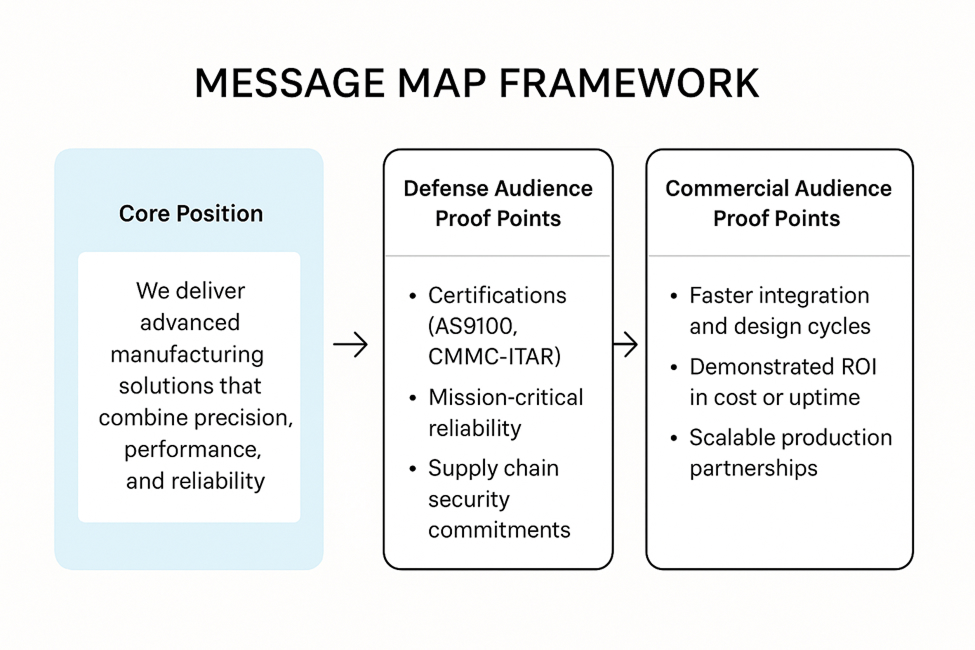
This kind of structure protects your consistency. It ensures your brand equity travels intact across audiences without creating competing versions of your company.
Most positioning challenges start inside the company, not in the market. When leadership, sales, and operations describe your business differently, customers notice the disconnect first.
Before entering a new market, bring your team into the story.
This isn’t about scripting. It’s about alignment.
When every person in your organization can explain what you do and why it matters, your company becomes more confident, consistent, and credible—no matter who’s in the room.
Manufacturing is inherently technical, but buyers still think in terms of outcomes. They want to know how your work makes something better, faster, safer, or more reliable.
Avoid jargon-heavy explanations. Instead, frame your results around impact:
Those examples make your value concrete. They help people visualize the difference your company makes, not just the products you produce.
As your company grows, so does your market. Your message must evolve with it. Schedule regular positioning reviews to ensure clarity and consistency. Ask:
This isn’t rebranding, it’s maintenance. A unified position, revisited quarterly or annually, keeps your business grounded as you diversify and grow.
Manufacturers that sustain growth across markets don’t do it by changing who they are; they do it by owning who they are and communicating it clearly, everywhere.
A single, aligned position anchors your diversification strategy. It builds trust with defense partners, credibility with commercial buyers, and confidence across your own teams.
At Anthology Communications, we help advanced manufacturers define their center of gravity, one story that flexes for every audience.
Because when your message scales as effectively as your production, growth doesn’t dilute your identity; it amplifies it.
Why positioning—not persuasion—determines who gets noticed.
Every manufacturer competing for state or federal attention faces the same challenge: decision-makers are overwhelmed. They’re flooded daily with proposals, reports, and statistics that all claim impact and demand urgency. It doesn’t take much before they all start to sound the same.
You can’t out-shout that noise. But you can stand apart from it.
It’s about strategic positioning—communicating your company’s value in a way that aligns with policy priorities, builds credibility, and strengthens your competitive footing.
At Anthology, we help clients communicate with government stakeholders every day. The difference between getting noticed and getting ignored isn’t in how much information you share. It’s in how you frame it.
Policy doesn’t live in a separate lane from business. It shapes the environment in which you operate. Grant structures, workforce programs, and infrastructure investments all affect your cost, speed, and scalability. Engaging policymakers isn’t about politics; it’s about risk management and opportunity design.
Manufacturers who treat policy engagement as a core market channel, one that requires clarity, cadence, and value alignment, gain a structural advantage over those who ignore it.
Manufacturers often lead with data: jobs created, units produced, dollars invested. Those numbers matter, but they rarely have the power to persuade.
While people forget statistics, they remember stories that connect numbers to outcomes.
Think about the last company that caught your attention. Was it because of a spreadsheet or a dashboard? Or was it a story about how their work improved lives or strengthened communities? Policymakers are no different.
The most effective manufacturers use data to prove, not lead, their narrative.
When policymakers can see themselves, or their constituents, in your narrative, they are more likely to remember your name when new initiatives emerge.
Many manufacturers struggle with visibility, not because their results are weak, but because their message lacks context.
Policy decisions are made through the lens of current priorities: job creation, supply chain resilience, defense readiness, and regional competitiveness.
If your message doesn’t connect to one of those, even your most compelling wins can get lost in the noise.
These statements connect your business to a broader policy narrative. They tell decision-makers: We’re part of the solution you’re trying to build.
The biggest missed opportunity isn’t being rejected—it’s never being considered.
Too many manufacturers begin relationship-building after funding or partnership announcements are released. By then, the key conversations have already happened.
Visibility in the policy space is established long before the RFP is released. To get ahead:
When decision-makers already recognize your company and understand your relevance, you’ve shortened the path to “yes” long before you ask for anything.
Trust isn’t earned with a single announcement. It’s built through repetition and reliability.
One of the fastest ways to lose credibility is to appear only when you need funding.
Sporadic visibility signals that your engagement is transactional. Consistent communication shows that you’re invested in the long-term health of the manufacturing ecosystem.
Think of your policy visibility like an engine: it doesn’t need to roar, but it should never stall.
A steady cadence could include:
Consistency builds confidence—and confidence, in turn, builds opportunity.
Manufacturers build the systems that power economies, secure supply chains, and strengthen national resilience. But somewhere between procurement codes and performance metrics, many forget that human impact is the differentiator.
You don’t have to be the loudest company in the room to be the one that gets remembered. You just have to connect meaning to metrics—showing how your innovation, investment, and people translate into public good.
At Anthology, we’ve seen that the manufacturers who rise above the noise share three traits:
When your positioning connects people to policy and results to relevance, you stop chasing attention—and start commanding it.
How employee advocacy strengthens your workforce pipeline and your public reputation
When manufacturers discuss workforce development, the conversation often begins with training programs, recruiting events, or partnerships with local schools.
Those efforts matter. But they only solve half the problem.
We have seen something powerful happen when manufacturers recognize that their best recruiters aren’t sitting in HR. They’re already on the floor, in the lab, and in the office. Your employees are the most credible advocates and your most persuasive marketers.
The real question isn’t whether you have great people. It’s whether those people are equipped and encouraged to share the pride, innovation, and opportunity that make manufacturing a career worth choosing.
In today’s talent market, it’s a strategic lever. CEOs and plant managers who amplify employee perspectives are doing more than building culture; they’re shaping brand perception, attracting skilled labor, and showcasing the innovation driving American manufacturing.
Research from The Manufacturing Institute and Deloitte shows that nearly 65 percent of Americans have a positive view of manufacturing, yet fewer than 30 percent would encourage their children to pursue it. That’s not a perception problem; it’s an awareness gap.
People trust people more than they trust campaigns. When an engineer or technician explains what they build or why it matters, it cuts through corporate noise and makes the work relatable. These aren’t “stories” in the abstract—they’re living proof of what modern manufacturing really is: high-tech, purpose-driven, and full of growth potential.
Unfortunately, many manufacturers still view communication as an HR function rather than a business asset. They assume the issue is outdated stereotypes—dim lighting, dirty floors, repetitive work. In reality, the challenge isn’t negative perception; it’s invisibility. Too few people see what manufacturing actually looks like today.
That’s where employee advocacy comes in. It turns your workforce into your most authentic, scalable communication channel.
Before employees can effectively champion your company externally, they must first understand it internally. When people know what they do, why it matters, and how their work impacts customers or national priorities, they speak with pride and precision.
To build that connection:
When your workforce feels connected to purpose, advocacy happens naturally and authentically.
Employee proof isn’t about scripts or hashtags, it’s about structured authenticity. You’re not telling people what to say; you’re giving them the confidence and channels to say it well.
Here’s how to do it:
When employees share their perspective, they send signals: This is what opportunity looks like here.
Workforce development isn’t just about filling jobs. It’s about creating visibility, aspiration, and belief in what manufacturing can offer. Your employees can do that better than any campaign.
When you empower your people to speak proudly and publicly about their work, you’re not just building culture, you’re building competitiveness.
At Anthology, we help advanced manufacturers turn employee advocacy into a strategic growth tool. Because when your people are your storytellers, recruitment stops being a campaign. It becomes momentum.
For leaders in advanced manufacturing, one of the toughest challenges isn’t in the lab or on the production floor. It’s in the halls of state capitols and local government offices. Whether you’re building semiconductors, advancing robotics, or strengthening aerospace supply chains, your ability to communicate value to policymakers can be the difference between winning the next bid or watching your competitors get the funding, attention, and workforce support you need.
Small and mid-size manufacturers are the backbone of regional economies, yet their impact is often invisible to decision-makers juggling competing priorities. State and local officials shape the business climate every day—through workforce programs, infrastructure investments, zoning, tax incentives, and energy policy. When they understand what your company contributes to the community, they’re far more likely to champion policies that help you grow, compete, and innovate.
Policy is part of your cost stack. Every workforce grant or infrastructure investment affects your margins—whether you plan for it or not. The manufacturers who see policy as a controllable variable, not background noise, are the ones who gain speed, access, and long-term advantage.
The challenge is that policymakers aren’t engineers or plant managers. They think in terms of people, progress, and public good. They need stories that illustrate jobs created, families supported, and technologies that secure the region’s future. Data alone doesn’t move them—context and narrative do. That’s why the most successful manufacturers aren’t just building advanced products; they’re building understanding and relationships that position them as indispensable to local prosperity.
We’ve found five tenets that help manufacturers communicate their value to policymakers—and turn those connections into lasting competitive advantage.
Legislative aides and local staff are the first to review your materials, and in our experience, they often spend less than three minutes doing so. Many are young professionals without deep exposure to manufacturing, logistics, supply chain, or technology. If they don’t understand your impact, your investment opportunities will be nonexistent.
A better approach is to understand what drives their priorities. Is the state legislature prioritizing career and technical education over four-year degrees? Is a regional council focused on job creation in rural areas?
Shaping your story around their initiatives helps you get noticed. And getting noticed keeps you out of the discard pile and into the consideration set.
There is a persistent misconception that policymakers only care about data. If you take that approach, you might be forgetting that policymakers are actual humans. And just like most humans, they don’t remember numbers. They remember stories. Rather than starting with retention rates or productivity metrics, frame the impact of your company in human terms:
Data should complement the story, not overshadow it. Policymakers are far more likely to recall the manufacturer who opened its doors to students than one who cited a percentage increase in efficiency.
Even if your story is strong, it loses its power if it only lives in one channel. Think about how your business can create, develop and repurpose content across a variety of channels and marketing activities. A press release should be repurposed as a briefing sheet for a state senator’s weekly roundup. An industry award should be amplified in trade media, LinkedIn posts, and local chambers of commerce newsletters. Consistency across formats builds credibility and helps your organization stand out from your competitors.
You don’t always have to be the one carrying the message. Sometimes the most effective messenger is a partner, customer, workforce leader, or employee. Policymakers are more likely to trust voices they already know. Consider who in your network can serve as your “Paul Revere,” — the credible, connected advocate who ensures your story reaches the right ears.
Adults consume an average of 13 hours of information daily. To stand out, your message must be repeated often, across multiple platforms. What may feel redundant to you is actually reinforcing your value to others. Policymakers are juggling hundreds of competing priorities. Repetition ensures your company remains top of mind when decisions about funding, partnerships, or procurement arise.
Manufacturers across advanced materials, semiconductors, robotics, and defense technologies play an essential role in national security and economic growth. But the impact you make locally is what policymakers remember. By combining audience insight, storytelling, channel strategy, credible messengers, and consistent repetition, you can transform your company from one of many to a category of one.