

Date
November 24, 2025
Category
Diversification

How manufacturers can expand across industries without diluting their identity
Diversification is growth’s great paradox. For manufacturers expanding into new markets, especially those in both defense and commercial sectors, the real challenge isn’t always production, capital, or capacity. It’s consistency.
The most challenging question in growth isn’t what you build next. It’s how you describe who you are when different audiences expect different things.
Defense buyers value stability, compliance, and reliability above all else. Commercial buyers prioritize speed, adaptability, and innovation. Both expectations are valid, but if your message shifts too much between them, your company can start to sound uncertain.
At Anthology, we often see this moment: manufacturers are ready to scale, but their market position hasn’t yet caught up. The solution isn’t two different stories; it’s one well-defined identity that flexes intelligently across audiences.
That constant—your anchor—is your strategic core. It’s the problem you solve, the value you create, or the purpose that drives your growth. When it’s clearly defined, every new partnership, product, or proposal connects back to something stable.
Here’s how to find it:
Many teams discover they’ve been describing their company differently for years. Once everyone aligns around one central idea, expansion becomes less chaotic, and growth communication becomes deliberate and disciplined.
Different buyers demand different proof points, but that doesn’t mean you need different identities.
A defense customer may require evidence of reliability, cybersecurity compliance, and audit history.
A commercial buyer may prioritize agility, cost, and speed to market.
Your identity stays the same, your examples change. We often help clients create a Message Map, a single-page framework that keeps the core value narrative at the center and shows how that story adapts for each market.
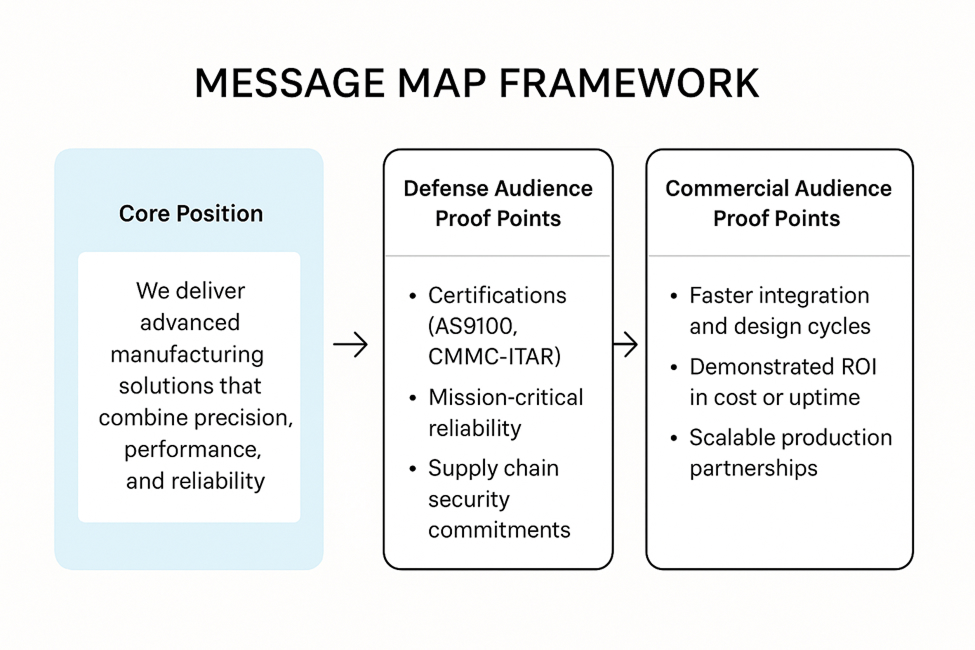
This kind of structure protects your consistency. It ensures your brand equity travels intact across audiences without creating competing versions of your company.
Most positioning challenges start inside the company, not in the market. When leadership, sales, and operations describe your business differently, customers notice the disconnect first.
Before entering a new market, bring your team into the story.
This isn’t about scripting. It’s about alignment.
When every person in your organization can explain what you do and why it matters, your company becomes more confident, consistent, and credible—no matter who’s in the room.
Manufacturing is inherently technical, but buyers still think in terms of outcomes. They want to know how your work makes something better, faster, safer, or more reliable.
Avoid jargon-heavy explanations. Instead, frame your results around impact:
Those examples make your value concrete. They help people visualize the difference your company makes, not just the products you produce.
As your company grows, so does your market. Your message must evolve with it. Schedule regular positioning reviews to ensure clarity and consistency. Ask:
This isn’t rebranding, it’s maintenance. A unified position, revisited quarterly or annually, keeps your business grounded as you diversify and grow.
Manufacturers that sustain growth across markets don’t do it by changing who they are; they do it by owning who they are and communicating it clearly, everywhere.
A single, aligned position anchors your diversification strategy. It builds trust with defense partners, credibility with commercial buyers, and confidence across your own teams.
At Anthology Communications, we help advanced manufacturers define their center of gravity, one story that flexes for every audience.
Because when your message scales as effectively as your production, growth doesn’t dilute your identity; it amplifies it.