
Date
December 15, 2025
Category
Diversification
You already know your capabilities. You’ve spent years, maybe decades, refining them. However, when every company in your space claims to be “best in class,” capabilities alone cease to be a differentiator.
What moves the needle now is how well you understand and use the research behind your story.
Because research goes beyond a data exercise. It’s how you uncover what truly sets you apart.
Most manufacturers have a general sense of their strengths. But there’s often a gap between what you believe your story is and what the market actually sees.
“We don’t start with what you think your story is. We start with what the market actually sees.”
When Anthology conducts a landscape assessment, we look at your competitive environment — who’s saying what, who’s being remembered, and where the white space exists.
Sometimes the results confirm what you already knew. More often, they reveal what’s missing.
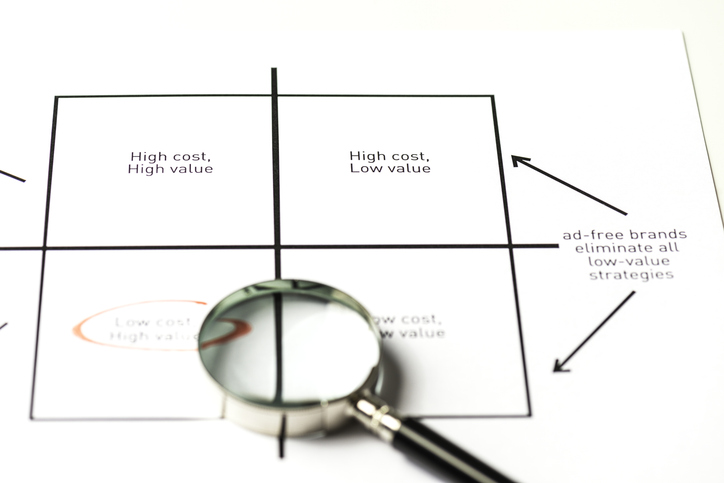
Good research doesn’t just tell you how you stack up against others. It tells you what to stop saying.
“Sometimes research isn’t about what to add. It’s about what to stop saying because everyone else already is.”
Everyone’s talking about innovation, workforce development, and community investment. Those are table stakes now.
What’s rare is proof. And proof comes from specifics: certifications, compliance records, longevity, and capital investment strategy.
Those are the details that move you from capable to credible.
There’s a temptation to assume certain things automatically matter to your audience. Certifications, compliance, years in business…
But until you’ve done the research, you don’t actually know which of those proof points move the needle.
“Research helps you figure out which proof points are worth putting front and center, and which ones your audience doesn’t value as much as you think.”
Perhaps your buyers prioritize cybersecurity and CMMC compliance due to their position in the supply chain. Or maybe they’re focused on sustainability and workforce stability. Either way, you can’t guess. You have to validate.
When you use research to understand what your market values most, you can prioritize the story elements that prove you belong in their consideration set instead of wasting time emphasizing the ones that don’t.
Longevity is powerful, but only if it’s positioned through insight.
“Sometimes, the most powerful story is that you’ve been here 30 years and that you’re still evolving. But you have to know if that matters to your audience before you lead with it.”
Research helps you determine whether your track record builds confidence or if your audience is more focused on what’s next: innovation, automation, or workforce expansion.
When you use research to see how your audience perceives maturity versus modernization, you can balance both stories.
That’s how you turn experience into evidence, and evidence into credibility.
The companies that win aren’t necessarily the ones with the most impressive metrics. They’re the ones who translate those metrics into meaning.
“We take what we find in the research and build it into the story. That’s how it sticks.”
Research gives you proof for your message, but a story gives it power. A capability statement or an ISO certification by itself is just information. But, when you connect it to the larger narrative, i.e., how you support national security, how you strengthen your regional workforce, it becomes a differentiator.
Manufacturing is evolving fast. Private equity is flooding in. Policy priorities are shifting every quarter.
If you haven’t revisited your market position in the last year, you’re probably behind on how others are talking about themselves.
“If you haven’t revisited your position lately, you’re probably missing how fast everyone else is changing theirs.”
Research helps you stay proactive, enabling you to lead the narrative rather than react to it.
Every strong story starts with something measurable. When you understand your market, the policies, players, and proof points, you stop relying on assumptions and start communicating from a position of authority.
“When you understand the landscape, you stop reacting to competitors and start leading the narrative.”
Because the companies that know their story best don’t wait for someone else to define it for them. They build it, back it with research, and use it to grow in every direction: new markets, new clients, new opportunities.That’s what it means to compete beyond capabilities.